

An Edge Gateway is not a smarter router. It is the first point in a system where raw sensor data becomes a decision. Before a single byte reaches the cloud — or doesn’t — the gateway has already done the hard work.
More Than a Protocol Translator
The textbook definition says an Edge Gateway connects local devices to a wider network. That’s technically accurate but misses the point in industrial and medical deployments. A standard network gateway forwards packets. An Edge Gateway interrogates them.
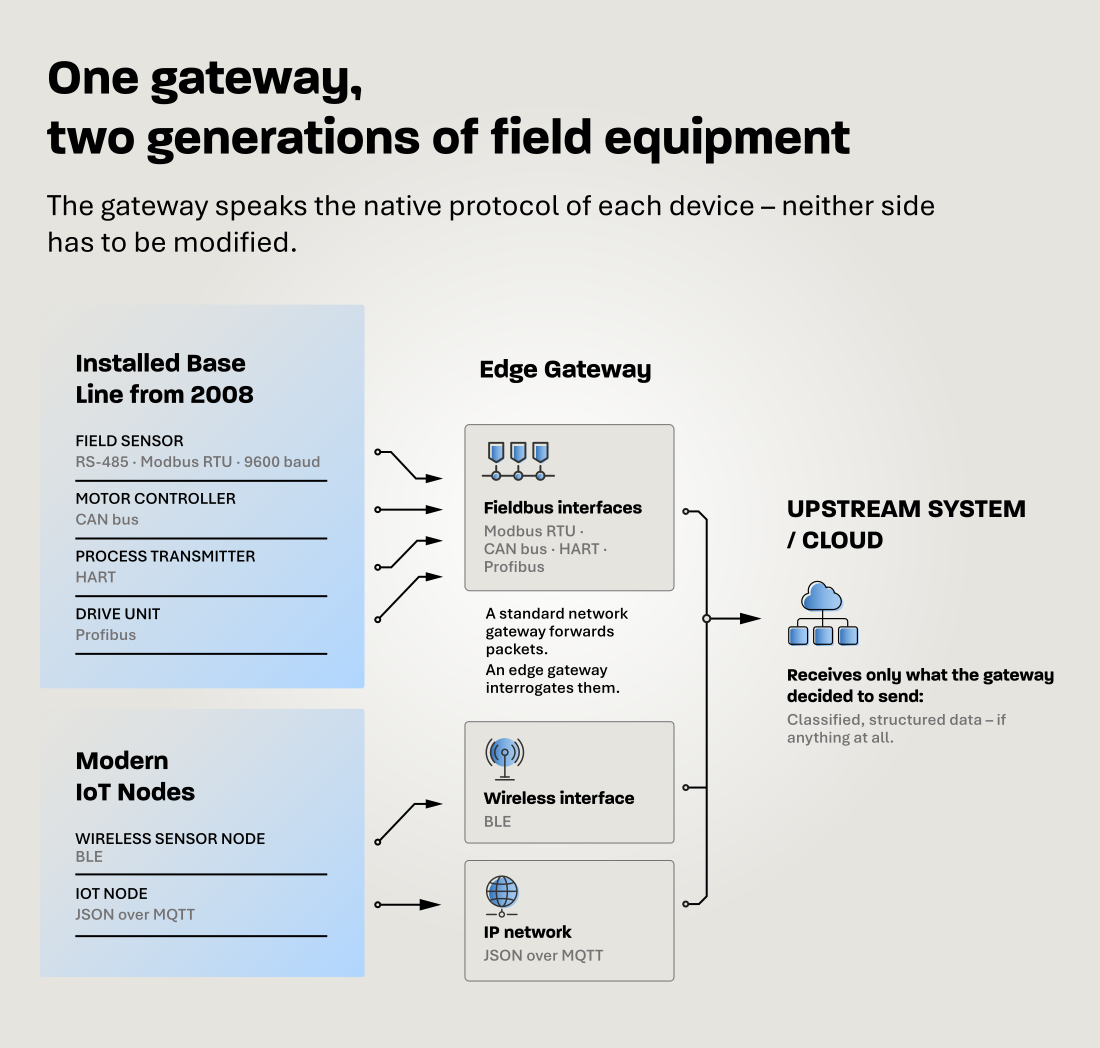
An Edge Gateway bridges legacy field devices and modern IoT nodes without requiring modifications to either system.
In practice, a gateway in a well-designed system handles several distinct functions simultaneously:

Speaks the native language
Legacy field devices: Modbus RTU, CAN bus, BLE, HART, Profibus.

Runs local logic
Evaluates what the incoming data actually means.

Decides what to send upstream
If anything at all, before the network is involved.
The filtering and classification happen before the network is involved at all.
The distinction matters because most industrial environments are not greenfield deployments. A production line commissioned in 2008 may still rely on sensors communicating over RS-485 at 9600 baud. Those devices often sit alongside modern IoT nodes streaming JSON over MQTT. The gateway must bridge both environments without requiring modifications to either system.
What Runs Inside the Gateway
The processing capability is what separates an Edge Gateway from its simpler predecessors. A modern industrial gateway typically runs on a multi-core SoC with enough headroom to execute local inference models in real time.
The value of an Edge Gateway becomes clear when examining how data moves through the system.
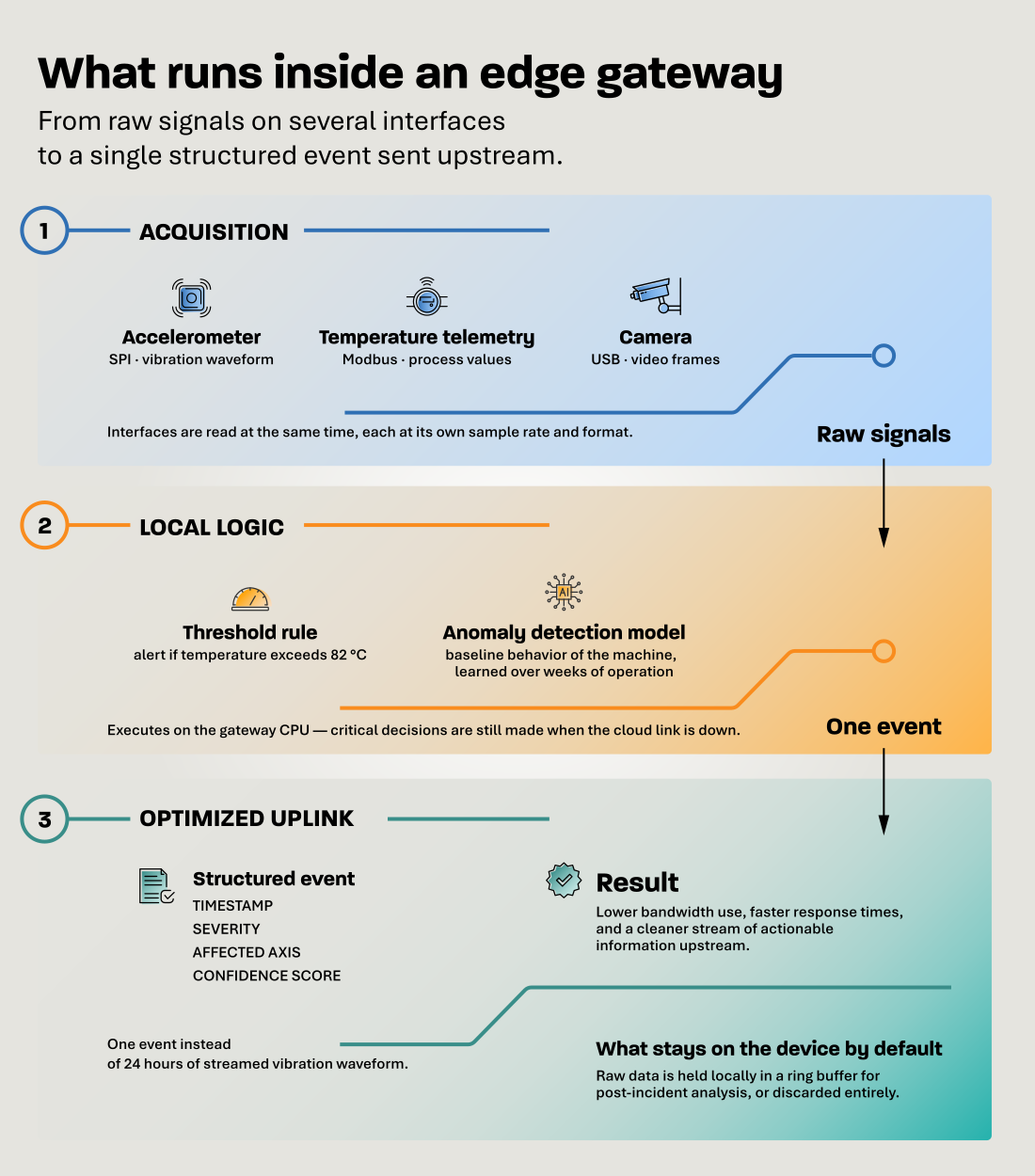
From raw signals to a single structured event: acquisition, local logic, and optimized uplink.

Temperature and vibration sensors on a centrifugal pump.
1. Acquisition
The gateway polls or listens on multiple physical interfaces simultaneously. A single unit might be reading vibration data from an accelerometer over SPI, temperature telemetry over Modbus, and video frames from a camera over USB — all at different sample rates and formats.
2. Local Logic
The raw signals pass through a processing layer. This can be as simple as a threshold rule (“alert if temperature exceeds 82°C”) or as complex as a locally deployed anomaly detection model that has learned the baseline behavior of the machine over weeks.
This logic executes directly on the gateway CPU with no dependency on network availability. That means critical decisions can still be made even if cloud connectivity is interrupted.
3. Optimized Uplink
Only the output of the local logic is transmitted upstream. Instead of streaming 24 hours of vibration waveforms, the gateway sends a single structured event: timestamp, severity, affected axis, and confidence score.
The raw data may be stored locally in a ring buffer for post-incident analysis or discarded entirely. The result is lower bandwidth consumption, faster response times, and a cleaner stream of actionable information reaching the cloud.

Why Off-the-Shelf Gateways Often Don’t Fit
Standard industrial gateways cover common cases well. They become inadequate at the edges of the specification, which is exactly where industrial and medical deployments often end up.
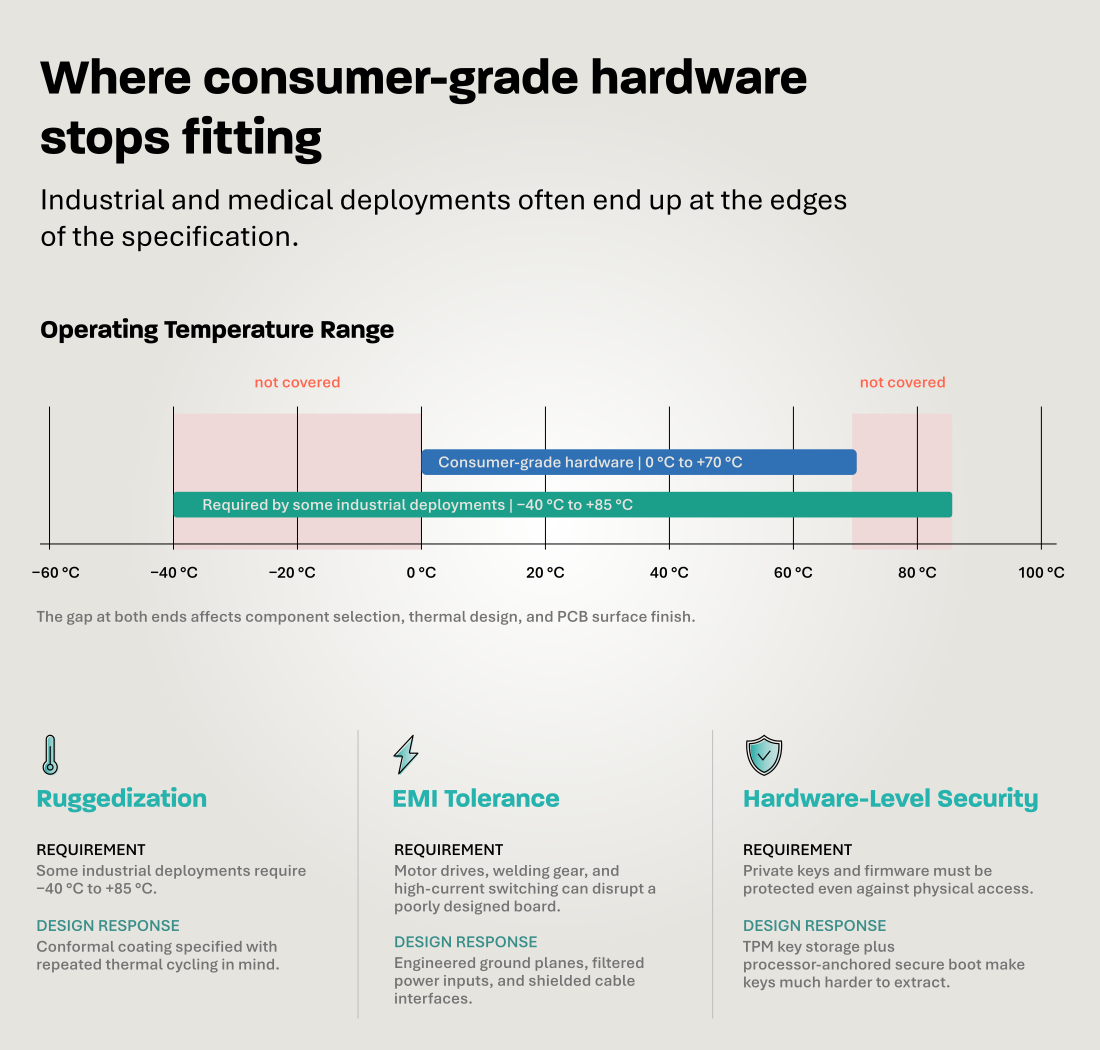
Hardware-level security is frequently required under IEC 62443, critical-infrastructure standards or government procurement specifications.
Ruggedization
The operating temperature range for consumer-grade hardware is typically 0°C to 70°C. Some industrial deployments require -40°C to +85°C, a range that affects component selection, thermal design, and PCB surface finish. Even details like conformal coating need to be specified with repeated thermal cycling in mind.
EMI Tolerance
Heavy industrial environments — motor drives, welding equipment, and high-current switching systems — generate electromagnetic interference capable of disrupting communication on a poorly designed board.
Custom gateways with properly engineered ground planes, filtered power inputs, and shielded cable interfaces are often a necessity rather than an option.
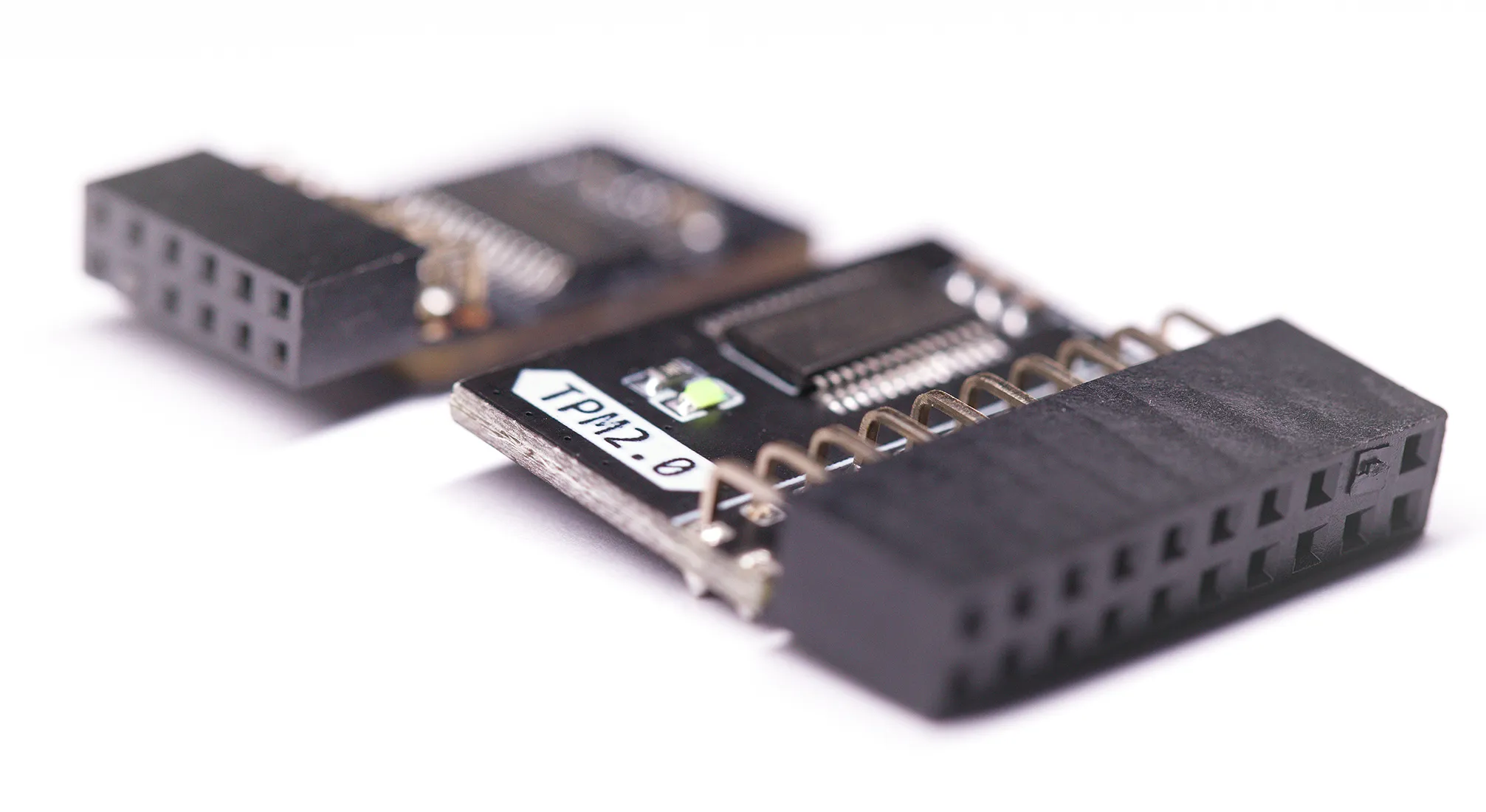
TPM modules provide hardware-backed key storage and enable secure boot.
Hardware-Level Security
A TPM (Trusted Platform Module) provides hardware-backed key storage and enables secure boot, ensuring that even physical access to the device cannot be used to extract private keys or install malicious firmware.
This level of protection is frequently required for deployments governed by IEC 62443, critical infrastructure standards, or government procurement specifications.
Summary
An Edge Gateway is the point where a raw stream of sensor readings becomes structured, actionable information. It is where data is filtered, contextualized, and transformed into decisions before it ever reaches the cloud.
Whether the goal is predictive maintenance, regulatory compliance, reduced bandwidth usage, or real-time operational visibility, the quality of decisions made at the edge ultimately determines the value of the entire IoT system. Getting the hardware and logic right at this layer gives every other part of the system — cloud analytics, dashboards, and remote management tools — something useful to work with.